
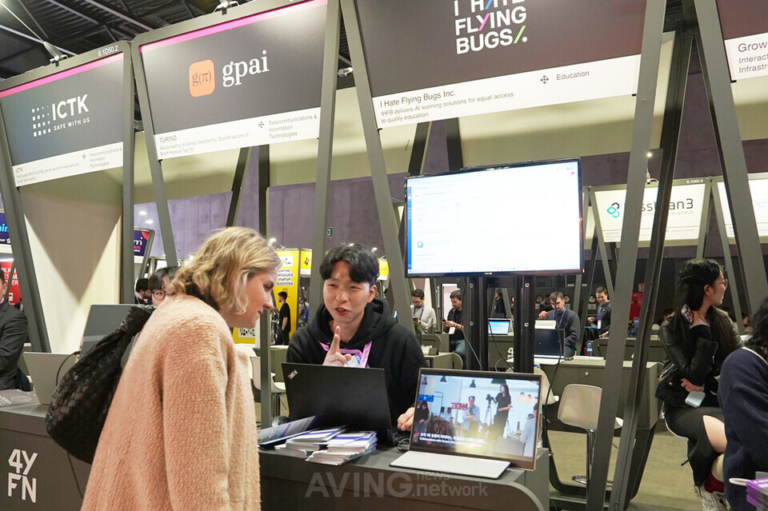
I Hate Flying Bugs (IHFB), an edutech company led by Park Chan-yong, participated in the startup exhibition 4YFN (4 Years From Now) at MWC (Mobile World Congress) 2026 held in Barcelona, Spain, from Monday, March 2nd to Thursday, March 5th.
I Hate Flying Bugs (hereafter, IHFB) is a domestic company that has developed and provided a proprietary learning platform based on AI (artificial intelligence) technology. The company explains that through its flagship service ‘Mil-Dang PT’ and others, it addresses the low completion rates and lack of management often cited as limitations of existing online lectures, implementing academy-level personalized management within an online environment.
Specifically, leveraging vast learning data, it precisely analyzes individual students’ weaknesses, implements optimized personalized curricula, and leads the way in universalizing quality education. Recognized for its unparalleled technological capabilities and growth potential, it is accelerating its expansion, including attracting large-scale investments.
At this MWC, IHFB primarily showcased its public education innovation software, which optimizes the AI Digital Textbook (AIDT) prototype first unveiled last year to suit each country’s characteristics. The company plans to publicly release its platform, designed to analyze each student’s learning achievement in real-time and suggest optimized learning paths, and pursue partnerships with public education institutions and companies worldwide to diversify its export model.
At the exhibition, IHFB highlighted its proprietary Deep Knowledge Tracing (DKT) algorithm as the key factor driving the competitiveness of its AIDT. This technology analyzes a learner’s past problem-solving history as sequential data, then predicts the probability of solving new problems with over 90% accuracy.
This helps identify knowledge gaps students may not recognize themselves, while the AI dynamically reconfigures the optimal curriculum in real-time to address weaknesses.
Additionally, the company unveiled proactive multi-agent AI technology that instantly detects when a learner’s concentration wanes or they encounter a problem-solving plateau. This public education-specific technology minimizes potential management gaps in the classroom, supporting improved learning outcomes through additional teacher guidance triggered by alerts or AI-based supplementary tutoring.
IHFB plans to accelerate the diversification of its global export model starting with MWC 2026. While currently discussing technology export agreements with key countries in Latin America and Southeast Asia, it envisions entering the European market—known for its advanced educational infrastructure—by proposing tailored B2G and B2B models aligned with each country’s systems.
Moving beyond simple software supply, it will also implement customized operational programs, such as hiring local staff to directly train teachers in technology utilization. The goal is to drive tangible changes in educational settings that are difficult to achieve through technology adoption alone and to differentiate itself from competitors amid the trend of expanding digital education.
An IHFBS representative stated, “Our modular software structure, which can be flexibly adapted to each country’s infrastructure environment, garnered significant interest from global buyers at this MWC,” adding, “Based on the network established here, we plan to pursue aggressive market expansion and customization to leap forward as a global AI SaaS edtech company.”
Meanwhile, MWC 2026, hosted by the GSMA (Global System for Mobile Communications Association), was held at the Fira Gran Via exhibition center in Barcelona, Spain, under the theme ‘The IQ Era (An Era of Converged Connectivity and Intelligence).’ This year’s event was the largest ever, attracting over 2,900 companies and more than 100,000 attendees from 205 countries worldwide. Key exhibition areas encompassed the entire ICT industry, including △AI Infrastructure △5G Advanced and 6G Pre-Technologies △Mobility △Fintech. Additionally, over 200 conference sessions featuring global leaders ran concurrently throughout the exhibition period.
